FAQ | BREATHALYZERS BY ALCOMATE
Frequently Asked Questions
Breathalyzer Frequently Asked Questions
OEM Customization and Business Cooperation
Branding, packaging, firmware, ordering, distribution, factory capability, and partner support.
Can you put our logo on it?
Yes. We support OEM customization. We can put your logo on the device body, packaging, and user manual. Some models also support your logo as the boot screen.
Can you customize packaging?
Yes. We can design color boxes, blister packs, manuals, stickers, and even gift packaging according to your requirements.
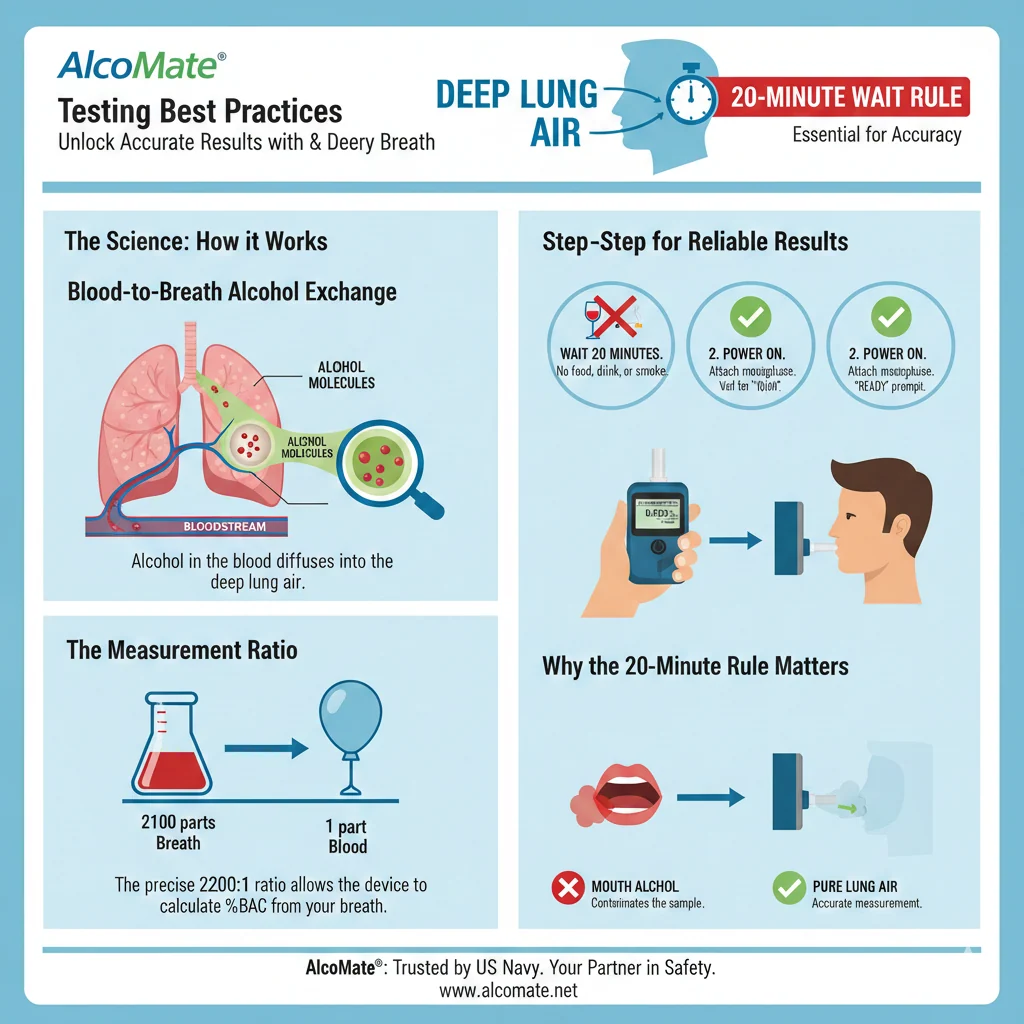
Avoid Contaminants: The mouth must be clear of “mouth alcohol” (residual alcohol from a recent sip), food, or smoke.
The 20-Minute Rule: You should always wait at least 20 minutes after your last drink before testing. This ensures that the alcohol in your mouth has dissipated, allowing the sensor to measure only the pure air from your lungs.

Can we become your distributor?
Welcome. We have distributor cooperation programs offering territory protection, technical support, and competitive wholesale pricing. For details, please contact us privately.
Can you customize firmware?
Yes. We can modify the boot screen, menu language, measurement range, alarm thresholds, data logging, etc. Firmware customization is available based on your needs.
Can you change BAC units?
Yes. We can set the unit to BAC (blood alcohol concentration percentage), BrAC (breath alcohol concentration mg/L), or g/L, etc. The default can be set as you require. Some models have a built-in menu so users can change it themselves.
Can you do OEM/private label?
Yes. In addition to logos and packaging, we can also customize the case color, software interface, language, manual, and accessory configurations. You bring the brand, we make the product. For the past ten years, we have professionally supported our customers' brands and do not build our own brand - and that will remain the case in the future.
What is the MOQ and price?
MOQ is very flexible. Sample orders can start from 1 unit, and bulk orders usually start from 50-100 units. Pricing varies by model and quantity; more customization means a higher price. Contact our sales team with your quantity and requirements, and we will provide a quotation the same day.
Are you really the manufacturer?
Yes, we are the source factory. We have our own production lines, R&D team, and quality control system. You can take a video tour of our factory or visit us in person. We have been an OEM manufacturer for several international brands for many years, with stable supply.
Do you provide technical support for distributors and OEM customers?
Yes, we do. We provide dedicated technical support for distributors and OEM customers: product training, repair training, technical documentation, after-sales ticket assistance, and custom development support. After cooperation begins, you will have a dedicated contact person.

Sensor Technology and Measurement Accuracy
Sensor types, measurement units, accuracy, temperature effects, and model selection.
What is a fuel cell sensor?
A Fuel Cell is a "fuel cell sensor" - the most common high-precision sensor used in professional breathalyzers. It reacts only to alcohol and is not affected by saliva, cigarette smoke, breath, etc. The readings are more reliable, with less drift, better stability, and a longer lifespan.
What is a semiconductor sensor?
A Semiconductor is a "semiconductor sensor" that uses a heated metal-oxide film to detect alcohol. It is inexpensive and responds quickly, but it can be affected by perfume, breath, smoke, etc. It is suitable for personal self-testing, not for law enforcement or professional evidence.
Why is a fuel cell sensor more accurate?
Because a fuel cell reacts only with alcohol, almost nothing else interferes with it, so the results are more stable and closer to the true value. A semiconductor sensor "reacts to all kinds of vapors" and is more prone to false readings; its accuracy also drops faster over time.
What does accuracy of ±0.005% BAC mean?
It means that under standard conditions, the reading from the device will not differ from the true blood alcohol concentration by more than 0.005 percentage points. For example, if the true value is 0.050%, the reading will be between 0.045% and 0.055% - very precise.
What is the difference between BAC and BrAC?
BAC is blood alcohol concentration, expressed in "%" or "mg/100ml", and is the standard commonly used in law. BrAC is breath alcohol concentration, expressed in "mg/L", and is the actual alcohol value measured in the breath. The two are converted using a fixed ratio, and the device automatically displays the result as BAC.
Why does ambient temperature affect the test?
Because the evaporation rate of alcohol is affected by temperature: in hot weather, alcohol evaporates more easily and readings can be higher; in cold weather, the opposite happens. Professional devices have temperature compensation, so we recommend using the device at room temperature, or choosing a model with temperature compensation.
How accurate is the breathalyzer?
Accuracy depends on the sensor grade. Our fuel cell models can achieve accuracy of ±0.005% BAC with good repeatability, on par with police-grade equipment. Semiconductor models are also fine for daily self-testing. Different models have different accuracy levels; for professional use, choose a fuel cell model.
What sensor does it use?
We offer two types: professional models use a fuel cell, personal models use a semiconductor. If you need it for business, fleet, or professional testing, we recommend a fuel cell model - it is more accurate and stable.
Testing Methods Professional Use and Compliance
Does the mouthpiece affect the result?
As long as the mouthpiece is clean and properly attached, it will not affect the result. However, a used mouthpiece can retain alcohol or saliva, so we recommend using a fresh one each time for hygiene and accuracy.
What is passive testing?
Passive Test is a passive test, also called "hands-free" or "no-blow" detection. The person simply speaks or exhales normally toward the device, and the device can "smell" whether alcohol is present. It is often used for quick screening and cannot be used as evidence.
What is active testing?
Active Test is an active test - the person blows firmly into the mouthpiece, sending deep lung air into the sensor. This is a formal measurement with accurate results, suitable for law enforcement or workplace testing.
What certifications/approvals does it have?
Our products are certified with CE, FCC, RoHS, etc. Some models also have professional certifications such as US DOT and European EN 16280. We can send you the certificate list for specific models.
Is it suitable for professional/workplace use?
Yes, it is. Our fuel cell models are designed for professional scenarios - factory, fleet, construction site, security, and other workplace screening. They are not toys; they are data-producing detection instruments.
How fast is the test and how many tests can it handle?
One test takes about 3-5 seconds to show the result, and the interval between consecutive tests is very short. A full charge can support several hundred tests - ideal for large-scale screening at factories, fleets, event entrances, etc.
Calibration and Maintenance
Why do we need to calibrate?
Sensors "tire" over time and readings can drift. Calibration uses alcohol gas of a known concentration to bring the device back to an accurate state - just like a scale needs to be zeroed after long use.
How often should it be calibrated? What are the ongoing maintenance costs and long-term stability?
Generally, we recommend calibration every 6-12 months (or after every 500-1000 tests). Fuel cell sensors have a long lifespan. The main maintenance costs are calibration and replacing mouthpieces. Long-term stability is excellent; with normal use, the device will work well for several years.
Can the device be calibrated locally?
Yes. We provide calibration methods and tools, so customers can do simple calibration locally. If professional calibration is needed, you can also send the device back to our factory or contact a qualified local metrology organization.
Do I need to send the device back to China for calibration or repair?
Not necessarily. Simple calibration can be done locally - we provide video guidance and calibration tools. Only when the sensor has aged or hardware is damaged would you need to send the device back to our factory for repair, or we can send the parts to you for local replacement.
Do you provide calibration software or calibration tools?
Yes, we provide them. We can supply calibration software, a calibration gas interface, and operation manuals, and train your technicians. This way you can calibrate locally without sending the device back.
Can the sensor be replaced separately?
Yes. Our sensor is modular and can be replaced directly. It's like changing a battery - remove the old sensor module and install a new pre-calibrated module. The device immediately returns to full accuracy; no need to send the whole unit for repair.
Warranty Parts and After Sales Support
What happens after purchase?
We provide complete after-sales support: one-year warranty, lifetime repair service, free calibration guidance, and long-term supply of consumables such as mouthpieces and sensors. Non-human-caused damage is repaired free of charge during the warranty period; human-caused damage is repaired at cost.
What is the warranty period?
The whole device has a one-year warranty. During the warranty period, non-human-caused damage is repaired or replaced for free.
What happens if a device fails during the warranty period?
Simply contact us and send a video or photos to confirm the issue. If it is a quality problem, we will repair or replace it for free, and we will cover the shipping costs (as agreed in the contract). If it is just operator error, we will guide you through it remotely.
Are replacement parts and accessories available?
We supply them long-term. Mouthpieces, sensor modules, batteries, charging cables, protective cases, calibration tools, and other accessories are all in stock and can be ordered at any time.
Can we purchase mouthpieces, sensors and other consumables separately?
Yes. Consumables such as mouthpieces, sensors, batteries, and chargers can all be purchased separately at favorable prices. Bulk purchases receive additional discounts.